Instructional Design

Background
Bloom Med Spa (a pseudonym for a rapidly growing franchise) is a wellness and aesthetics brand operating in over 60 locations countrywide. Bloom Med Spa operates within a wellness industry competing heavily for the same market share. The majority of Bloom Med Spa's competitors use membership options and standardized sales procedures in order to boost retention and revenue. Bloom Med Spa franchises found their clients to consistently be "bargain botox shoppers" and not the repeat clientele that generated larger revenue. As part of a broader initiative to increase retention and brand image, the organization introduced The 4Ever Way. This method is a nine-step service model designed to standardize sales and experience across its locations. This instructional design project, developed as part of my graduate coursework in OPWL 537, focuses specifically on Step 2 of that model—The Warm Welcome. This step trains new Patient Care Coordinators (PCCs) to create a strong first impression by establishing rapport, using intentional communication techniques, and setting the tone for a positive client experience.
My instructional design team and myself were able to provide an instructor-led session to equip early-in-the-workforce learners with the confidence, clarity, and consistency to greet clients professionally while establishing brand value in the spa experience. The result of our design is a 30-minute face-to-face session tailored for effective results for our client via smart scripts, job aids, and instructor-led role play. This step of the process will provide the foundation on which each franchise can grow their membership and retention efforts.

Analysis of Needs, Learners, Tasks, and Environment
The need for this training emerged from inconsistencies observed across locations in how clients were greeted. While some PCCs naturally offered warm, professional interactions, others lacked clarity on expectations or confidence in their approach. The goal was to improve consistency and ensure all clients experienced a seamless, welcoming entry into the spa environment.
This training builds on prior onboarding modules covering company values, the PCC role, and Step 1 of the 4Ever Way. The Warm Welcome training focuses entirely on Step 2 and was designed to be brief, practical, and impactful.
The client served as both the project sponsor and subject matter expert, offering deep insight into the PCC role and expectations for client engagement. A needs analysis revealed that while most PCCs understood their customer service responsibilities, they often varied widely in their approach to welcoming clients. This inconsistency—particularly in greeting style, body language, and timing—affected customer satisfaction and potentially undermined conversion opportunities for services and memberships.
Learners for this training are newly hired PCCs, often with some background in front-desk or hospitality roles but little familiarity with the franchise service standards. The training is delivered in person at the spa’s breakroom and designed to fit within a larger onboarding sequence that includes eLearning modules on the company’s mission, culture, and client journey.
To ensure alignment with business needs and adult learning preferences, the project integrates multiple instructional design models including Gagné’s Nine Events of Instruction, Keller’s ARCS model, and Merrill’s Principles of Instruction. These frameworks helped ensure that the content was motivating, relevant, and performance-based.
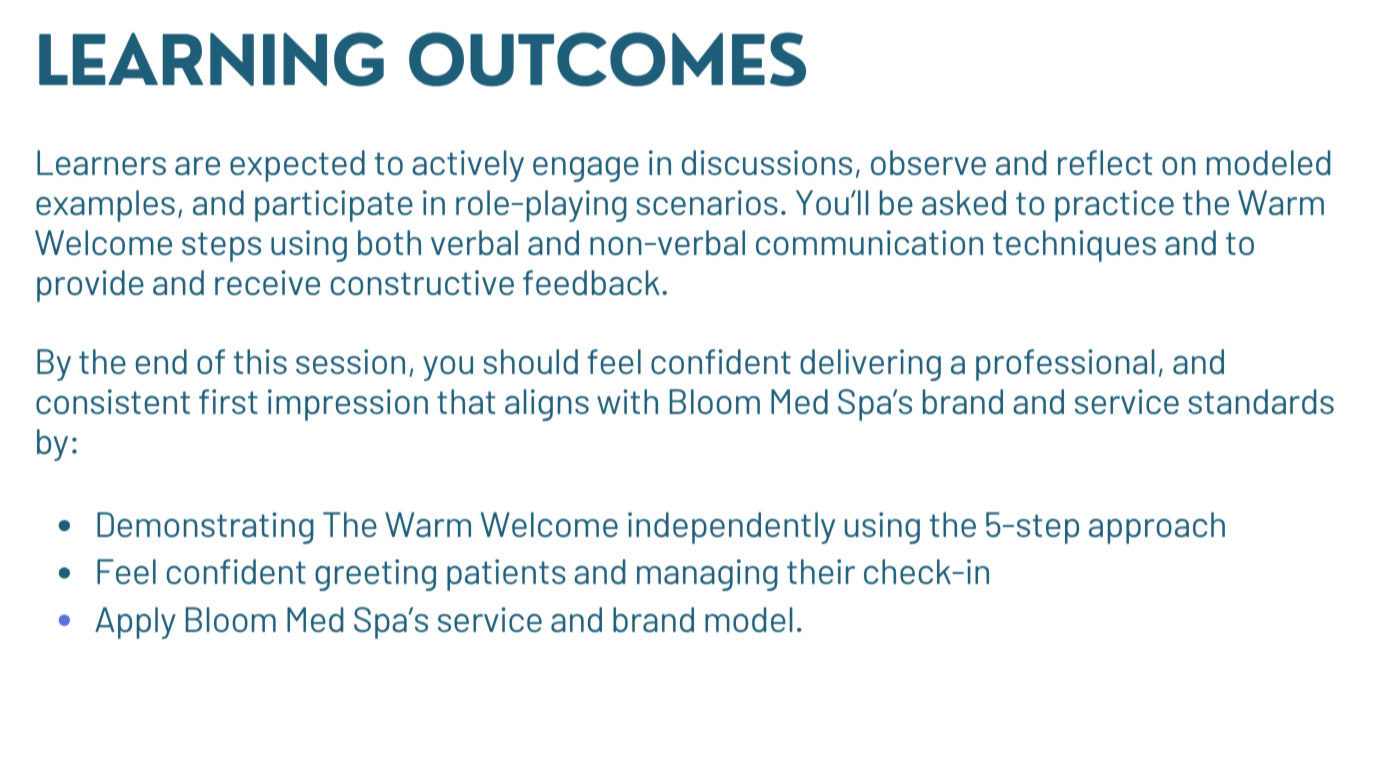
Lesson Plan Overview
The 30-minute lesson was built using Gagné’s Nine Events of Instruction, Keller’s ARCS Model, Merrill’s First Principles, and the Show-Tell-Do-Check method.
Instructional Segments:
eLearning Refresher – Reconnect with prior training; set expectations
Warm Welcome Technique – Model best practices; explain rationale
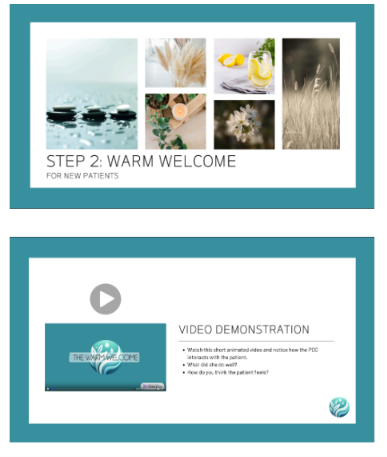
Video Demonstration – Analyze examples of effective and ineffective greetings
Role Play Application – Practice real scenarios with feedback and peer coaching
Closing – Reflect, reinforce, and prepare for real-world transfer
INSTRUCTIONAL MATERIALS
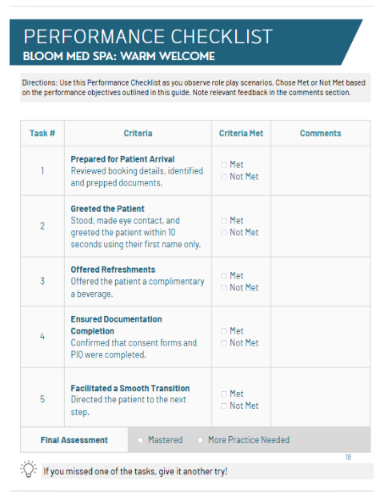
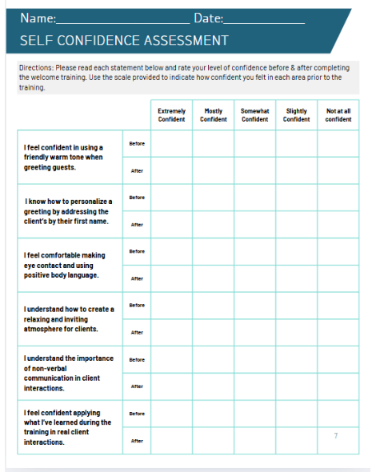
To support delivery, our team created a full suite of instructional materials tailored to both facilitators and learners. These include a detailed Facilitation Guide, a Learner Guide with space for reflection and notes, and a Quick Reference Guide designed to remain at the front desk for on-the-job reinforcement. A Performance Checklist is used to assess behavior during role play, and a retrospective Self-Confidence Assessment allows learners to measure their progress. The training also includes a short video demonstrating both ineffective and effective examples of a Warm Welcome. Scenario cards help learners practice handling a variety of real-world client interactions with professionalism and empathy.
All materials are intentionally designed to be intuitive, supporting consistent delivery by facilitators. By encouraging facilitators to treat learners with the same warm welcome as dictated by the training, facilitators lead the way in modeling and instructing an engaging experience.
Note: Deliverables are available upon request. Sharing externally is pending client approval.
A Sample of Instructional Materials
Reflections
PRECISE OBJECTIVES: This project underscored how even a short training requires precision in determining the scope of work and strategic alignment with business goals. One of the most valuable takeaways for me was the importance of designing learning experiences that transfer knowledge and business value but also stay tightly within scope.
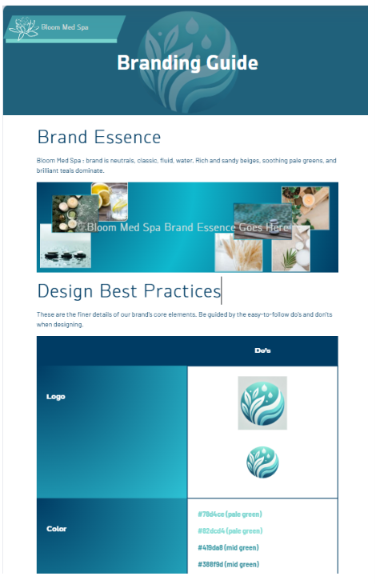
Because our scope of work was tucked within a broader training initiative, this project challenged us to refine every performance objective and to reflect that in the work. Every activity, material, and interaction was evaluated against its ability to support the performance objectives, which helped keep the scope focused and the training impactful. I also deepened my appreciation for the art of simplification—learning that focused training materials are often the most effective. Working with a wellness franchise also provided the chance to apply color and rich design elements, and use a branding guide to design aesthetically pleasing deliverables.


TEAM COMMITMENT: This project also challenged me as a team-player, and to learn how to better work within a team of talented individuals. As many of my teammates were professionals with a lot of knowledge within the craft, I not only learned from them but gained a deeper appreciation for the strengths and challenges of communicating and working in a virtual creative environment. Without a strong team, this wouldn't have been a strong project and I am a better designer as a result.
PROJECT MANAGING IN A MOVING ENVIRONMENT: I appreciated learning how to better manage a project within an environment in which everyone is experiencing multiple demands and has entirely differing ideas of accomplishing the end result. Flexibility within adherence to the goal was key. Setting and achieving milestones was critical to success.
LOOKING AHEAD: I plan to build on this experience by refining my skills in creating scalable training, and to work in different topics as to grow in confidence as a designer. I have a greater understanding of how to generate milestones and timelines, as well as pitfalls, in order to work collaboratively moving forward. Furthermore, I look forward to tackling future projects by building upon the foundational blocks of my experience.