PERFORMANCE-DRIVEN
PROJECT MANAGEMENT
This project shared with permission from the project sponsors.
Background.
The PML (Process Management Lab) is a 100% virtual organization dedicated to supporting small to medium sized non profits by volunteering to provide process improvement services to those in need. The PML accepts new interns four times a year, and employs lab associates to volunteer with the Lab. Lab associates may be current students, or former OPWL students. The associates and interns have fluctuating time and resources to provide to the PML, and while interns are required to provide 45 hours of work this rarely calculates to a set amount of hours per week. Furthermore, the work the PML undertakes for clients is based on obtaining a client with need, which can happen inconsistently.
Project sponsors, the leaders and founders of the PML, had received feedback identifying a need for a more formalized intern onboarding experience. Furthermore, the project sponsors felt as if they were spending too much time training available volunteers and assigning tasks when a client was obtained, leading to work jamming up. And as a virtual organization, the project sponsors realized they had various places storing resources and documents as well as uneven communication methods. As a result they wanted to increase communication and collaboration and decrease silos. After reviewing the collection of concerns, the sponsors rejected multiple solutions and instead agreed that a project management software was the solution. They did interviews and surveys with the current interns in order to determine what intern experience might be ideal. The project sponsors also started writing out the steps of their process management process with external clients. They began to brainstorm how to transfer projects into their selected PM software, Asana.
My job was to determine how to transfer processes, projects, and determine how the users would approach a project, how collaboration could occur, and how project sponsors could best utilize the project management software.
The Challenge.
New interns arrive four times a year to the PML, and constitute a large portion of PML staff. These interns also often opt into staying additional semesters and transition into associates. How effectively interns onboard can also impact how readily available and competent they are as associates later.
Interns voiced concerns regarding the onboarding experience. Interns didn’t always feel prepared for issues that came up, or fully immersed in the PML early on in their experience. As a result, project sponsors conducted interviews and surveys with recent interns. Project sponsors concluded that the onboarding process should include PML specific reading material, key information, a mentorship process, and provide a framework to assist interns in understanding what was required of them.
Framed as a gap analysis in the HPT model (Dessinger et al., 2012), the problem looks like this:
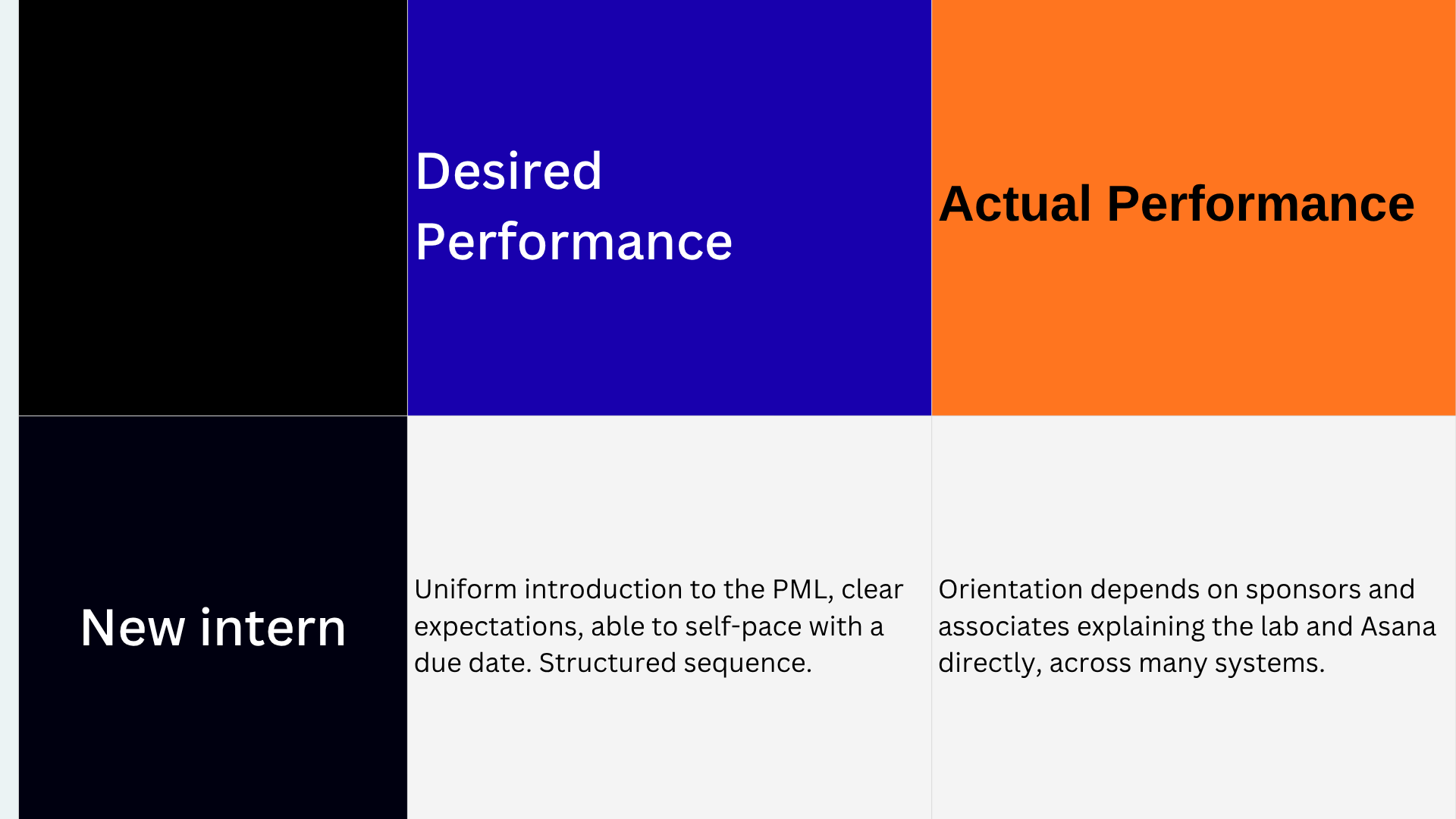
My challenge was to assess a new gap: how to use project management software to meet the needs they identified, and provide a project that met the intervention requirements they identified.
Analysis and Methodology.
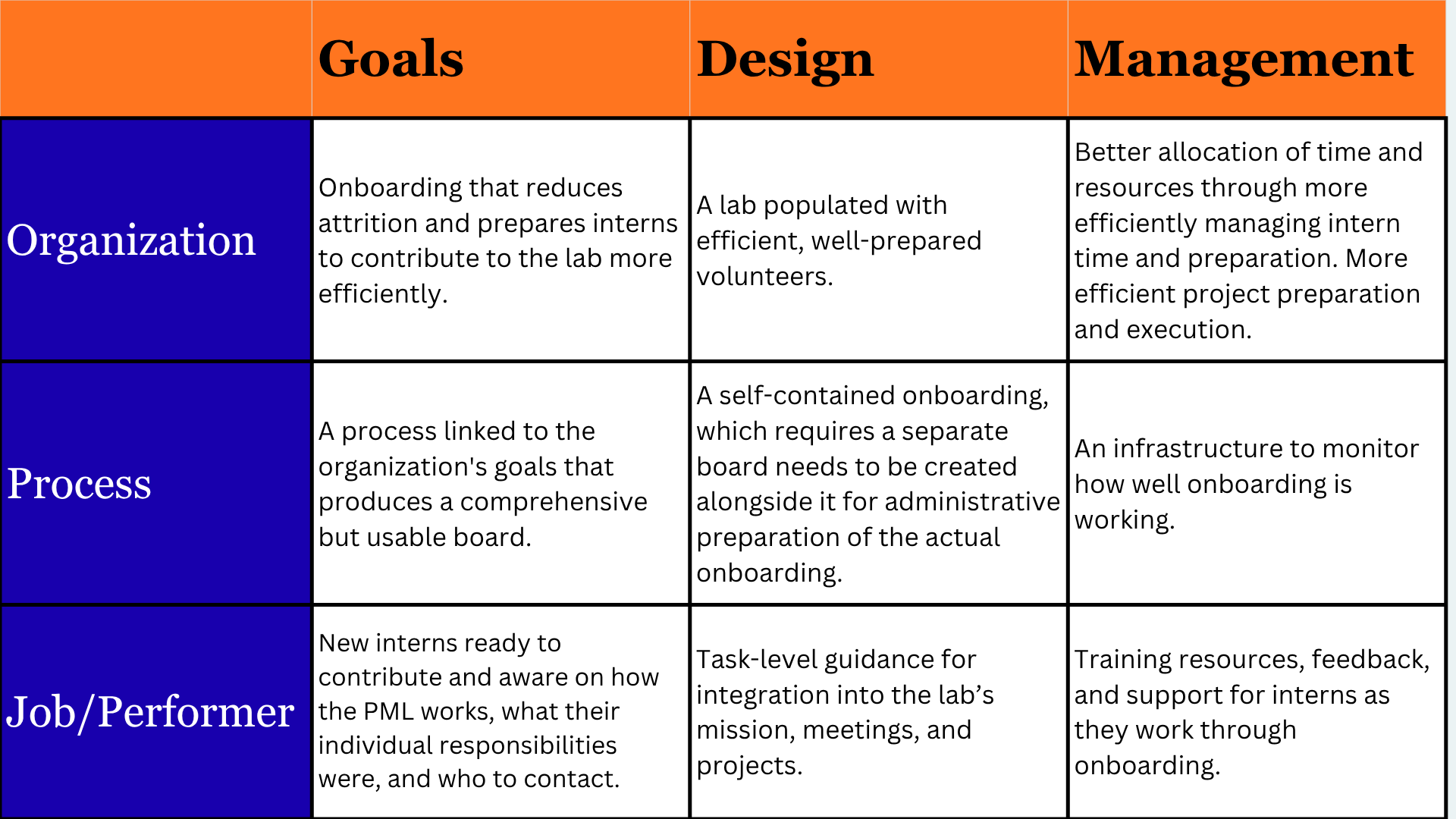
RUMMLER-BRACHE 9 Box Model
A process change can mean changes to job responsibilities and the skills needed to carry them out, and overlooking those links is a common reason process changes fail (Rummler-Brache Group, n.d.). In order to root the changes in the right place, and consider systematically how onboarding would impact other aspects of the organization, I utilized Rummler and Brache’s Nine Box Model. Here I was able to gauge impact on other aspects of the organization, as well as determine what the organization needed.
My gap - creating a usable, working product to the solution of a uniform intern onboarding experience - meant I worked at the process level first, aiming to design a self-contained onboarding that provided instructional materials, expectations, and information to a defined performer/learner profile with built-in methods to monitor how well onboarding worked. Using all the categories of the box to inform project design decisions, I approached the project challenge from the job/performer level next to create task-level guidance and methods for interns to provide feedback.
Learner and Environmental Analysis (LEA)
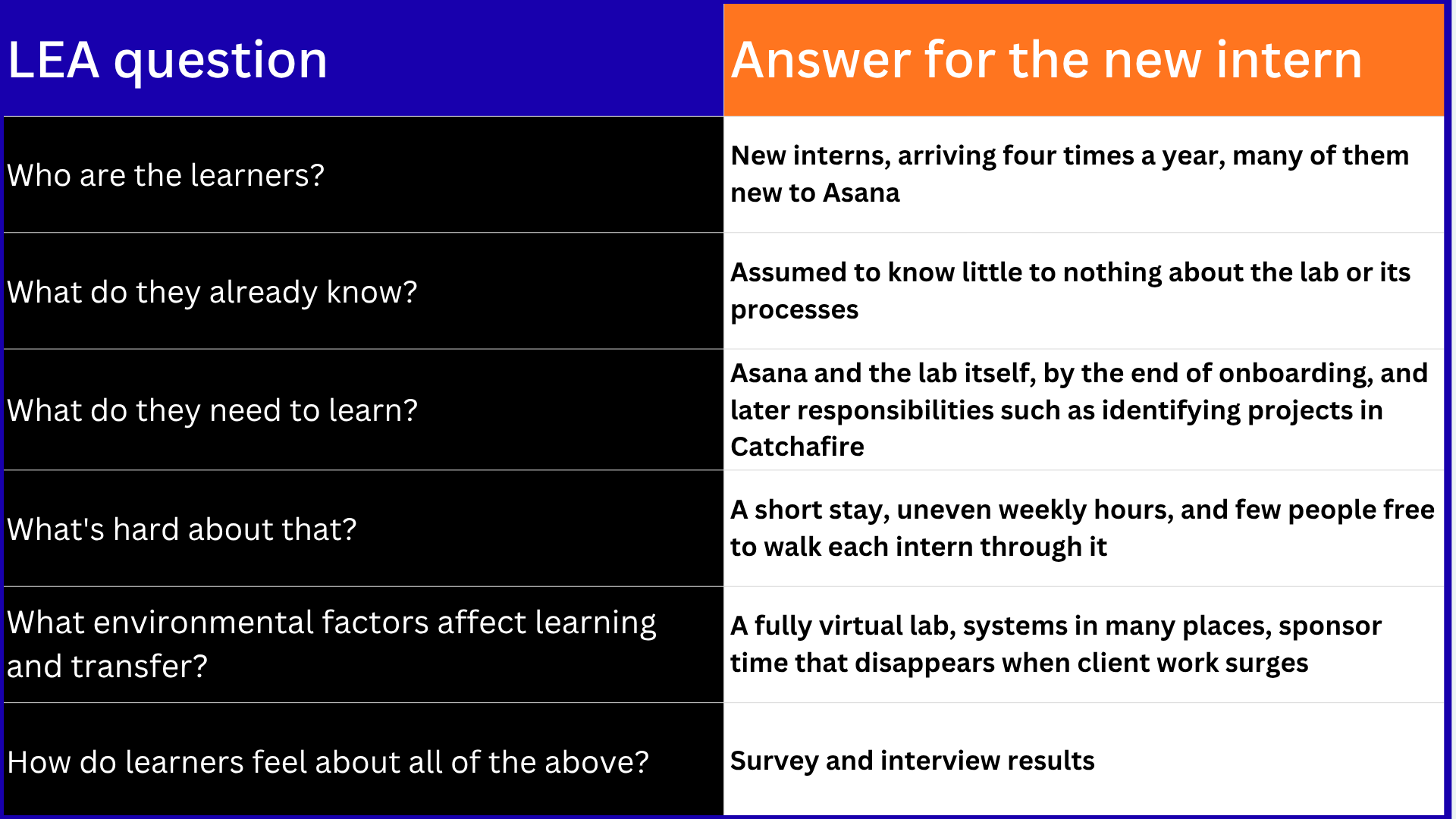
My user analysis leaned on the two halves of a Learner and Environmental Analysis (LEA) from the LeaPS instructional design model (Giacumo, Villachica, & Stepich, 2024). The PML’s unique make-up of volunteer employees with different levels of expertise or introduction to the PML meant that not everyone would use the same boards or understand the same information.
I identified three user groups for the lab's boards:
1) Interns or brand new learners/entering Asana users—prominent because the PML could assume no prior knowledge or expertise in PML functions.
2) Current PML learners, presumably lab associates.
3) Project management facilitators such as leadership or an Asana project manager/designer.
The Onboarding board would need to be designed for the first group, as interns would need a project that assumed little to no information about the PML.
Learner analysis. LeaPS frames LEA around six questions.
Environmental analysis. The environment side asked what the lab needed from the system, independent of any one learner. The lab needed new interns to get oriented in a uniform manner, with performance aids to supplement learner knowledge instead of people. Furthermore, in a virtual environment centralizing the information made sense.
Design.
For all performance-aid project management, I discarded the idea of using Kanban or Agile style boards. In the case of these boards, I found it important to leave the boards in List View. List view allows for a more chronological feel, providing clear tasks, due dates, and easy access to change the status of the task. In this case, the project sponsors determined they wanted to divide the onboarding into several phases. Each phase could be segmented with separate due date ranges and differentiate the phase of internship. This meant tasks went from very specific instructions with performance aids attached to larger items, such as attending weekly meetings. The use of Phases also helped interns understand what was expected of them over the course of the internship.
I created these phases down the board. I also encouraged project sponsors to apply the learner-use identified earlier. Each task shouldn’t make sense to a project sponsor (who acted as project SME), but instead should read clearly to the learner with little to no prior knowledge of the PML or PML onboarding experience. Asana tasks in these boards should have a conversational, instructional tone explaining each task and how to access pertinent materials.
Using an Asana board for intern onboarding also allowed for a layer of organizational oversight.
One such aspect was being able to gauge the anticipated time of the internship onboarding process, as interns were only required to provide 45 hours to the PML. As identified in the Rummler-Brache 9 Box, this onboarding needed to support organizational goals as well. As a result, one such tool was a method for the PML to measure anticipated time allocated to the organization, as well as a method for the interns to provide feedback through recording actual time on each task.
Another method of organizational and process oversight Asana can provide is the ability to determine who has access to the board, allowing for stakeholders to see where the intern is in process or to allow the intern to ask questions easily. In order to aid this, I created a process in which only specific stakeholders are added to the board. They can then access the board at any time to provide assistance or determine where the intern is in the process.
Using my initial analysis using Rummler-Brache 9 Box, I determined that two projects were needed; one for the intern specifically, and one for the administrative team creating the intern onboarding each semester.
The project sponsors were uncertain, so I was able to create a few “Mock-Ups” for the Project Sponsors to visualize and select from.
The decision was made to create two boards, providing two templates that could be adjusted and used each onboarding cycle.
I identified that interns would need to also understand how to use Asana in order to utilize their onboarding. I designed a first iteration of a video, which later was used in a separate iteration of the training. It provided the foundation for the video in use at this time.
Using Asana in this way allowed for each task to work as an instructional tool and performance aid, creating a uniform onboarding for each intern.
I also worked with the project sponsors to design a board which I often call a “mirror board,” which reflects all the tasks that are required in order to launch the intern onboarding board. In a way, it’s a reflection of the intern onboarding board itself.
This example contains the most recent iteration designed in order to better assist the administrative load of the tasks, and re-labelled the Phases as time prior to the next intern onboarding cycle.
It’s labelled Template because it’s designed to be a “master board,” permitting for large scale iteration to happen simply within the board through collaboration.
Outcome + Results.
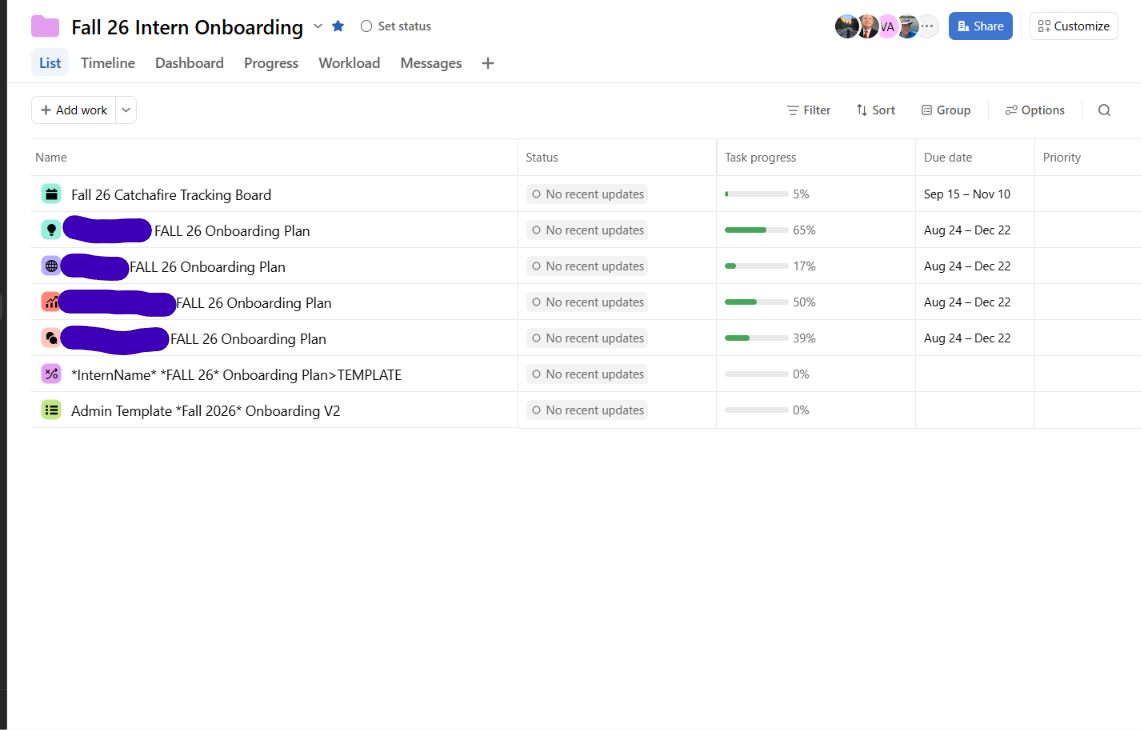
This board was deployed and has been used successfully for several semesters. Results have been positive in that students have access to and complete successfully the requirements of the intern onboarding. Project sponsors have been pleased with the outcome. Review of the work has provided evidence that interns are using the board to at least 50% completion, with the average being higher. SOPs have been developed around when a board is created, where it is stored, and when it is archived.
Using a systematic and systemic approach, evaluation methods have been built into the board process and provide oversight into the intern onboarding experience. However, future iterations may contain a survey or other methods of obtaining feedback. Using Asana means that these can be developed directly into the board or a task.
Reflections.

Leadership Impact
The project sponsors wore many hats: PML leadership, Subject Matter Experts (SMEs), direct stakeholders as well as upstream and even in the case of the admin board downstream stakeholders. While not unusual for a smaller organization, it created an environment where the project sponsors might be in a position of authority while also being developers and inevitably administrators. In this case it often worked for designing the product and working collaboratively on how it could interact organizationally. However, it’s important to note because upstream administration and downstream participants often hold different and sometimes competing priorities (Chyung, 2019). Developing evaluation procedures that do not involve PML leadership may be required for future growth of the project. Alternatively or in conjunction, using risk assessment early to determine if the PML leaders might inevitably create a risk and what impact it would be may offset future issues.

Scope of Project - Break it Down
While only being “one project,” this project identified why a WBS is so important. A Work Breakdown Structure divides project work into progressively smaller pieces, organized around deliverables rather than actions. Heagney (2016) describes several ways to organize the second level, including phases, major deliverables, functions or departments, and geography, and notes that most WBSs need at least three levels. In this case, our “one deliverable” was in fact multiple deliverables: mock-up boards, board design, task creation, video creation and job aid, and admin board. When deliverables are too large, or require expertise, having a WBS is a valuable part of adequately assigning deadlines, resources, and combatting risk. It also highlights the value of task dependency, which Heagney identifies as the first step in turning a WBS into a schedule. It is a finish-to-start dependency: in supporting the project above, the admin task has to finish before the intern task can start. The admin board is a needed deliverable. Mapping this out prior to starting work on a project could help project completion with a volunteer and changing workforce.
References.
Cady, S. H., & Shoup, Z. D. (2016). Competencies for success. In W. J. Rothwell, J. M. Stavros, & R. L. Sullivan (Eds.), Practicing organization development: Leading transformation and change (4th ed., pp. 117–133). Wiley.
Chyung, S. Y. (2019). 10-step evaluation for training and performance improvement. SAGE Publications.
Dessinger, J. C., Moseley, J. L., & Van Tiem, D. M. (2012). Performance improvement/HPT model: Guiding the progress. Performance Improvement, 51(3), 10–17. https://doi.org/10.1002/pfi.20251
Giacumo, L. A., Villachica, S. W., & Stepich, D. A. (2024). [title and publisher still needed from your copy of LeaPS]
Heagney, J. (2016). Fundamentals of project management (5th ed.). AMACOM.
Rothwell, W. J., Hohne, C. K., & King, S. B. (2018). Human performance improvement: Building practitioner performance (3rd ed.). Routledge. https://doi.org/10.4324/9781315299471
Rummler-Brache Group. (n.d.). The nine boxes model. https://www.rummlerbrache.com/nine-boxes-model